
Ask Our Authors February 2026
| Features

Happy Publication Day everyone!
Our second Publication Day of 2026 brings a whole new collection of exciting stories, from a wonderful collective of talented authors!
To introduce them, we are continuing a fun feature for the year – Ask Our Authors – where we send all our newly published writers the same simple question to see how different each answer is…
For our January authors, we asked them: What piece of writing advice have you found the most valuable during the writing process for this book?
Here are their answers…
My best advice, write it as you would read it. We have all read books through our lives and if you are writing for a specific age group then transport yourself back to that age again. It makes the characters more accessible and its fun!
Gary Allan, author of Pablo's First Adventure
To actually find myself become a Published Author at the age of 61 is something I truly never expected!! This book came from a conversation I was talking about with my partner one Saturday night about my childhood when I told him I use to pull a Rollerskate behind me and talk to him calling him Derndy to which we both fell about laughing. Early next morning I awoke and pondered the evenings conversation and sitting in my lovely conservatory overlooking a lake, I picked up a pen and started writing the first chapter .Really excited and laughing I walked in the bedroom to wake my partner Steve exclaiming loudly ‘making him jump I’ve started writing a book you have to listen to it . After reading it a huge smile was on his face, and he said That is really good. So that was my inspiration. Next was my 6-year-old Granddaughter Evie when it was a sleep over and she loved it even suggesting new adventures I could write about Derndy and keeping the whole thing a secret until you offered me a contract. The only writing advice I can give would be to have a go as you never know what creative talents you have laying dormant. Book 2 is finished, and I cannot wait to share that too.
Shirley Ross, author of The Adventures of Derndy the Rollerskate
When writing books for children try to use a child’s imagination. A child always remains inside an adult and writing for children enables that child to re-emerge. I used to teach, and it was thrilling to be able to open the floodgates of my student’s imagination and combine it with the power of articulation. I hope my readers enjoy my books as much as I enjoy writing them!
Peter Taylor, author of Green the Bean
Because I am a poet for me it was this: To keep in mind that there is a difference between poetry and prose and the approach to the writing of each should never be mixed. They go at language from different points of view. Poetry shows, good poetry anyway, and tries not to tell. Also, it is good for the poet to keep in mind if he or she rhymes that rhyming, good rhyming, is not rhyme for rhyme’s sake; the rhyme if expected to be good must help the meaning of the poem. If one keeps these two things in mind: the language being different than the language of prose, and the rhyme not rhyme for the sake of one, one has a better chance at writing poetry that is good and could be even great. To this I might add, be careful with line breaks; try not to chop the lines; something much seen in the poetry of today. You have to have a good reason why you are breaking the lines where you do. Do not ever chop the lines to make it look like a poem is being or have been written. This shows lack of discipline, and that you are not or are not taking seriously the art of writing poetry. Poetry is an art and like any art it must be taken seriously, thus, try to develop it the most you can each time you sit down to write a poem; otherwise, you are not taking with utmost care the task of being a poet. It is one of the most admiring and profound endeavour man ever put his mind to.
Luis A. Estable, author of Seventeen Songs and These Given Sonnets
"I was advised to take regular coffee breaks, which I didn't do, since I'm a dedicated tea drinker. And still, although the idea of sipping lots of delicious tea appealed to me greatly, I found out the hard way, that once I sat down behind my computer, there was no stopping me. I was plowing on like fiend. Thanks to my loving husband I always started the day with a light breakfast, but as soon as he turned his back I stayed glued to my work. Being force fed my lunch at three in the afternoon and feeling queasy every evening, finally made me realize that something had to give. So, I put my stubbornness aside and changed my routine, if you can call obsession a routine. Instead of letting my hubby bring me a cup of tea which I then drank lukewarm, having ignored it for a couple of hours, I mended my ways, more or less. I now let Alexa remind me every two hours that I need to get up, move away from the screen and take a ten-minute pause. Needless to say, that I'm ignoring her regularly, but I try to have a delicious sandwich, kindly prepared by my better half, at the reasonable hour of one-thirty and to walk away from my desk at least two or three times during my working hours. I don't look at my phone but treat myself to a nice cuppa and a chat with my husband, if he's available.
I have to admit, since I don't treat tea breaks as wasted time anymore, but as a very important part of the writing process, I enjoy my work a lot more and I find, to my surprise and joy, that I'm being a lot more productive. The moral of this story? Never feel bad when you pause your work as much as you need. Your result will be all the better for it!
Carolyn Rosen, author of Fatal Resemblance
The most valuable advice I received was to write with truth, not with fear. I learned to have patience and perseverance, to believe that everything will work out, even when many say how difficult or impossible it is, and to trust that everything comes at the right time. Believe in yourself with all your heart and with faith. Do not lose your enthusiasm or your joy in the process. Do not let the flame of your desire to express yourself fade. Technique builds the structure, but truth and consistency build the impact. If you have something beautiful and meaningful to share with humanity, trust that goodness attracts goodness. Believe in you! Believe in G-d!????
Claudia Daher, author of R.A.T.S-Revolutionary Army Of Teens - We Are One
"It wasn't writing advice for this book in particular. It was a cool morning in early fall, and a literary agent, his age betrayed by the white of his hair glistening in the weak morning sun, advised me to pursue my interest in writing. He was responding to a short story I had written, more like a paragraph than a full-length story sent via email. I took a year off from work to start penning my first lines.
Rajeshree Varangaonkar, author of Meter and Rhyme
As a new writer, I have had a million people give me advice, but the piece of writing advice that has had the most impact on me as a writer is that the best writing comes from what you know. For this book in particular, I wanted to use a childhood memory and turn it into a fun and imaginative story. I used my own memory to create the story. When I would get stuck, the advice that helped me the most was to pause, take a moment, and think about myself as that child. I went back to that child and channelled my thoughts from that time in my life. I used what I remembered to recreate what I would have been picturing when I heard my mom say, "If you don't put them in the laundry, they are going to walk there themselves". I believe that staying true to myself, my own imagination, and my own memories helped me to create something special that I hope to bring joy to others.
Brooke M. Borden, author of The Adventures of Emma Jean's Jeans
"Just write, get it written down on paper or electronically. You can't expand or improve something you haven't started. Don't worry about what it looks like initially as it will go through lots of edits and fine tuning. Write for yourself. Remember what you may think is rubbish others will think is fantastic, not everyone likes chocolate... You don't need impressive educational qualifications to be a great writer. Accept there will be critics. Accept what they say and either use it or ignore it."
Liz Gillespie, author of Battlefields
"I consulted a friend of mine who has extensive experience in writing books. She told me to make sure I focus on the ""hero's journey"". People need to feel attached to the main character and want to follow what happens to them. For this, there should be the inciting event, followed by the adversity and challenges faced by the protagonist, the climax to the situation, and the rounding off at the end with either bittersweet sadness or a triumph. This is usually concurrent with a lesson for the reader. She also noted that very often, the action goes on right until virtually the last page, with only a short ending. Pay no attention to how many words you have written: if your book is 25,000 words or 250,000 words, make sure it's well-executed, and keep a ""cheat sheet"" so that you can keep up with what each character has done."
Alexander Petterson, author of Milda And The Melting Snow
The most valuable piece of advice about writing a nonfiction book was quite simple; do your research and be accurate as you can. This helped me focus and pay attention to detail whilst writing and as it is a book for children aged 9-12 years, I wanted to ensure that it would spark an interest in discovering people from history they did not know about. My ultimate aim was to bring the women whose stories I was telling to life and I did this by writing each chapter in the first person which I believed makes these stories more personal and relatable for children to read.
Tracy Hilton, author of Unsung Women: 30 inspiring and pioneering women across history
Edit, edit, edit and try not to fall in love with your own words.
Ron Kent, author of Blood of the Earth
Whatever success or disappointments you collect on your writing journey my first piece of advice is to keep on writing. It doesn't matter if it is a blog, short story, flash fiction, full length novel or a memoir. My second is to keep on reading other people's work to learn and gain inspiration from them.
D.A. Adamson, author of Rubbish: The Little Dog That Became A Street Cleaner
Since I write children's stories, I have found the most important advice I've been given is to talk to the children: in this case, my grandchildren. And then pouring another glass of wine is helpful too.
Patricia Callendar, author of Dragon Stories 1 - 5
I find this very difficult because all the advice that I have received so far is predicated on how to ensure sales. I must admit that when I am writing, I am not thinking of sales, I am riding a magnificent horse and enjoying every moment wherever it takes me. So I say, stay true to yourself - the written word is truly a gift.
Pria Pims, author of 1984-2084: A Century of Cynicism
Interestingly, I didn't receive any writing advice whilst creating my first book. I believed in the story and always had the child reader in mind which inspired me whilst writing it. My mission was to give young children the joy of their own imagination.
Ali Leclerc, author of The Moth and the Rainbow
Lose the adverbs!
In Stephen King’s primer “On Writing”, he admonishes new writers to ditch adverbs in favor of the right verb for the context. He suggests that the correct verb, once found, will surpass any modified lesser verb. For example, ran quickly could be replaced by skittered, darted, jetted, raced, or any number of alternatives which would suit the situation and match the context.
I have to add that the same is likely true (apropos) concerning adjectives and nouns. I have discovered that once the right word is found, as a writer you know it, because it sings. It doesn’t always happen, but I am keenly aware when it does. I strive to make it happen as much as is humanly possible. I can’t tell you how many times I call out from my library to my wife. “Hey hon what’s a better word for…?”
Salvatore A. Croce, author of The Gemini Chronicles
Having been a technical writer, I had to be literal and concise in explaining technical ideas for laypersons, understandable instructions and directions. So therefore, the writing was all telling. When I started writing fiction the one thing from critiques said to me the most was "show don't tell". That was something I had to work on for a long time to finally change gears from telling to showing. So, learn the art of storytelling that uses the five senses to make the story real and engaging to the reader.
Raven Jade, author of Legend of the Sea Witch
The most valuable advice came from my mentor long ago. She said that good writing often begins with allowing yourself to be playful, to try whatever--without having the "self-imposed" editor or judge interfere with your writing too early in the process. Giving myself permission to play with my words before judging them frees the writer within me to create and have fun while doing so. The "ruthless editor" in me does its work later.
Wilma Davidson, author of Super Cat! Splat! Splat!
1. Just write first; worry about editing later.
2. Focus on writing well, rather than writing quickly.
3. When making use of brainstorming, don't ""mentally filter"" through content in your mind. Be sure to jot down absolutely every thought, word or phrase that occurs to you - don't be in the habit of discarding inspiration before it's even had the chance to exist as ink.
4. Better not to write about personal pain and grief until you've come out on the other side with some insight or healing."
David O'Sullivan, author of A Deer in the Fog
Writing well is a lifelong pursuit. Read craft books, the classics of your genre, and current bestsellers. Study what endures and what sells. Hone your voice until it's unmistakably yours. Mine your own life for material, because lived experience is the richest fuel a writer has. There are no shortcuts worth taking. Sometimes the learning is uncomfortable, even painful, but suffering builds character, and character, as every good writer knows, is what builds the best stories.
Ines Gray, author of Angel Bite: Watchers and Warriors Series, Book II
The best piece of advice that I was given was, there will be days when writing does not flow and there will be others where it flows like water, the secret is to keep trying and no matter what anyone says keep going and you will get there, It took me six years to complete my manuscript.
Robert Catt, author of The Land of Tinksville
Firstly, Be confident in yourself. Believe in yourself that you are good enough and able, most of all never doubt, once doubt sets in you will find it so easy to talk yourself out of it, so don't let doubt in. Just believe. Secondly, believe in the storyline, go through it as many times as is necessary until you are confident that it meets your reader’s needs. For example, is it encouraging, is it funny, does it take the reader on a journey as they read etc. Then follow point one and don't doubt. Thirdly, believe in your character/s, are they relatable to the reader, can your readers identify with them in any way. Think about what makes your character’s stand out. Will your audience fall in love with them, if not why. Change them until you’re sure that they reader will love them or identify with them. People need to be able to interact with your book. Lastly Whatever you do, never quit. Always remember that winners never quit, and quitters never win.
Ian Campbell, author of The Adventures of Billy Bog Brush The Lock-keeper
"The most valuable advice that guided the writing of this book was ""Write the truth-without fear and without embellishments. My late husband recounted his escape from communist Romania with honesty, capturing not only the dramatic events but also the fear, determination and hope that carried him toward freedom. These are his own words and his personal testimony. By sharing his story, I believe his voice continues to live on - a lasting legacy of courage and truth."
Paul Costinel, author of Refugee in Turkey
The most useful advice I always stick to is don’t be tempted to edit the first draft while you write it. It is not expected to be good and will probably be messy. The editing phase will sort it all out. Persevere and keep going, it will all turn out okay in the end and probably better than you expected.
Elizabeth Ellen, author of Not My Cat
The advice that most resonated with me was firstly, not to over explain or describe. Trust the audience to imagine for themselves how things feel and how they look. I have always had a vivid picture in my mind of the characters and scenes when I am reading a book without a long description of them. Secondly, know where you are going with the story. Don’t get sidetracked. Everything must be relevant to the story and well paced. With that in mind, you should try to omit the parts that you personally would skip over when you are reading a book. And finally, one author suggested that you must always finish your book. So rather than struggle with one part, I chose to push on and finish the last chapter even though I knew other chapters were not really complete or satisfactory. Then I went back to refine the story again and again until I felt everything fitted into place and I was happy with it. I thought that was great advice because just finishing a book gave me a great sense of achievement. Regardless of how many people read it or like it, at least I know I have written a story and I enjoyed doing that.
Rosemary Embery, author of Only I Know
Years ago an old friend and mentor offered helpful advice on what to do when faced with “writer’s block”, that is when you get stuck and are at a quandary on what to write next. He said, “just plow ahead”. Start writing at the next or a related juncture of your conceptual outline. More often than not, you’ll arrive at the logical bridge or verbal description that eluded you when struggling with abstract thinking. This is because written language has a built-in logic and discipline that tends to flush out inconsistencies, non-sequiturs, and other errors as you go through the process of transforming rough concepts and impulses into complete sentences and paragraphs. You may have to go through multiple drafts. However, like a body surfer who avoids the menacing wall of a big wave by diving into it, you’ll likely surface at a place where you can see and navigate the next passage.
Kennedy Richardson, author of Sublime Dissonance
I found I took no advice writing this first adventure. I don't want to sound obnoxious but all I wanted to do was immortalise my dog Rambo aka Bubba Wubba, having adventures together with his real and some ficticious friends. I never want to forget my pets, theyre getting old now, and writing a book seemed a lovely forever memory of them. Although I'm an amateur there are many adventures in my head to hopefully be in print one day....
Karen Edith Robinson Andersen, author of The adventures of Bubba Wubba and friends.
Thank you to our authors for taking part in this feature!
Make sure to take a look at our newest titles in our “Latest Releases” category today!
and once again, Happy Publication Day everyone!
MORE FROM THE BLOG
-

Celebrating World Book Day
| Features
Every year on World Book Day, families, schools, and communities around the globe come together to celebrate the magic of stories. First established by UNESCO in 1995, World Book Day is a reminder that books are more than just pages bound together they are doorways to imagination, and ...
read more -
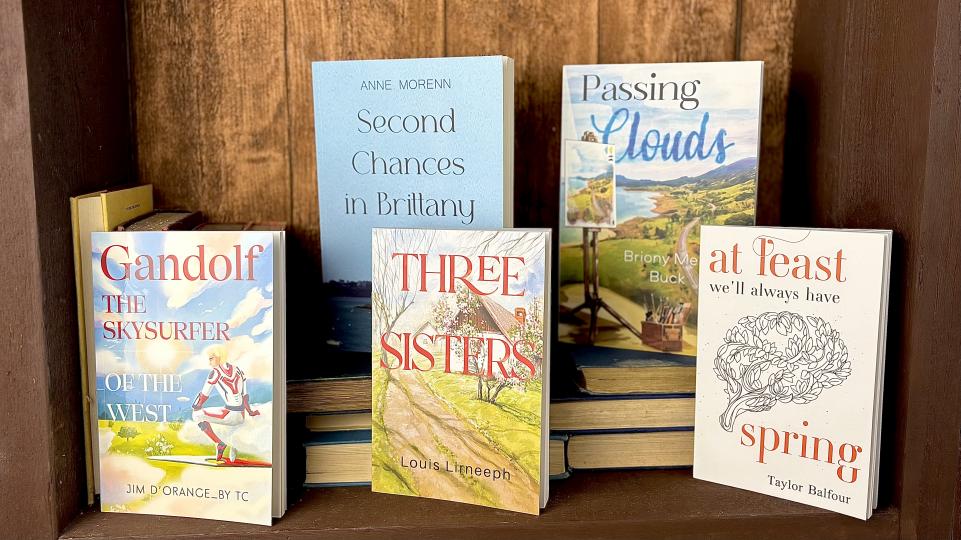
Five Picks from our Spring Collection
| Features
As we head into March, we can start to look forward to longer days and warmer weather. It is just around the corner! While we patiently wait for spring to really take hold, we have a selection of books to remind us of what is to come! Check out the five titles below, and many more titles, und...
read more