
Well-Grounded In Historical Fact - An Interview with Wes Loran
We spoke with Wes about his earlier, award-winning, writing experience, how he balanced historical fact and personal stories for...
We spoke with Wes about his earlier, award-winning, writing experience, how he balanced historical fact and personal stories for...
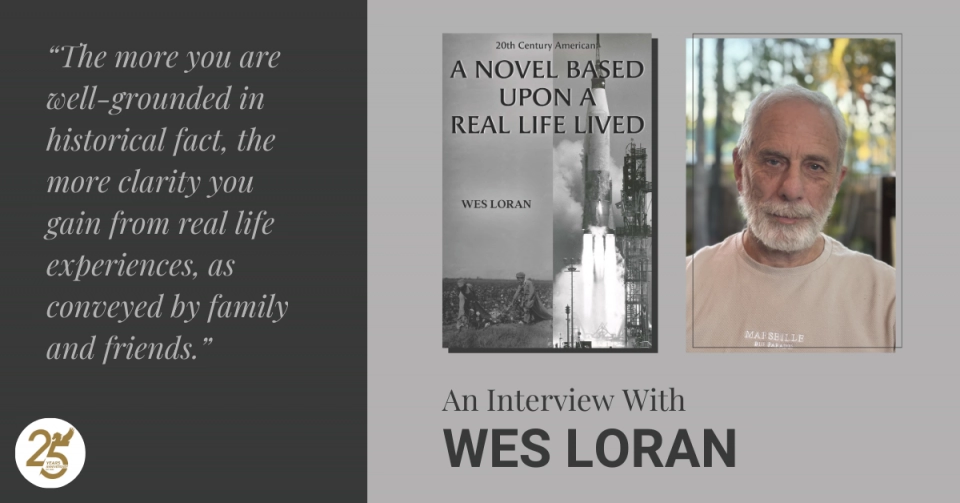

The 20th century called for great change around the world, but none more so than in the mighty United States of America. From mass oil-pumping to out-of-this-world space travel, the lives of American families were changed forever across just one generation.
For Wes Loran, this time-period offered the fertile ground to tell a monumental tale of perseverance, growth and resilience, based on the real-life story of his white farm laboring ancestor.
We spoke with Wes about his earlier, award-winning, writing experience, how he balanced historical fact and personal stories for his novel and if, from the very start, there was a greater story that he was aiming to tell.
In the spring of 1966, a high school editorial written by me called “Kaleidoscope” was submitted to the Quill and Scroll Society in America, which is focused on journalism. The piece was awarded a prize of $1,000 and in those days, it was enough to cover my living expenses for my first year at San Francisco State, which was a great help. Two years later, I transferred to UC Berkeley.
The piece focused on the adolescent angst of making decisions and whether to run away from them - suicide being the ultimate escape - or deal with them by connecting with life’s possibilities.
Actually, family stories provided a wealth of material for the novel but at the same time they ultimately generated a need to be factual. As a person who has always loved history, it was always going to be my fate to tie fact and fiction together. The more you are well-grounded in historical fact, the more clarity you gain from real life experiences, as conveyed by family and friends. It’s all a critical matter of context.
There was one storyline that provided the genesis for the entire novel. It was Carl’s loss of family and education amidst extreme poverty that underscored his heroic and resilient struggle. To set that stage, I had to delve into his family’s life prior to his birth. But everything that happened to him and all that he accomplished in his life against the odds flowed from this childhood loss and how he dealt with the consequences of that loss.
As temporarily frustrating as it was, I was finally satisfied with the ending after many attempts. I believe it was worth the extra time and effort from a creative standpoint.
What I have learned is that when writing a book, you must be patient with yourself and not rush the creative process. Quite frankly, too many writers spin a good story only to fall flat at the end. I don’t believe that was the case with me on 20th Century American. Taking the time and making the effort to arrive at the just-right conclusion for me as the author was the best path.
“What happens in the mind when we know we are slowly dying?” Answering that question about Carl allowed me to creatively explore the options to ending his story arc. I start with a story outline but let the telling of the story suggest what the ending should be like.
The second book of the 20th Century American trilogy follows the lives of four baby boomers, two females and two males, as they navigate their childhoods, youth, and maturation years from the late 1940’s to 1981. The protagonists are from different economic, social and racial segments of American society, as they transit through the gilded 50s, the turbulent 60s and into the uncertain 70’s. The story arc ends with the swearing in of Ronald Reagan as President.
The third and final book will remain a mystery to you as it is still a mystery to me.


We are honoured to work with as many authors as we do at Pegasus Publishers – each with their own stories to tell. Their worlds are singular, their characters are relatable, and their creativity truly knows no bounds. This is Author Life, a feature on the Pegasus Blog that opens the door to each of our author’s creative process and previous literary experience, offering you – the reader – an opportunity to learn a little about the mind, or minds, behind the novel. Marius Shovlin ...

We are honoured to work with as many authors as we do at Pegasus Publishers – each with their own stories to tell. Their worlds are singular, their characters are relatable, and their creativity truly knows no bounds. This is Author Life, a feature on the Pegasus Blog that opens the door to each of our author’s creative process and previous literary experience, offering you – the reader – an opportunity to learn a little about the mind, or minds, behind the novel. Dylan Lee Henders...

There's something special for an author about seeing your book through someone else's eyes. Every review offers a unique perspective, highlighting the moments, characters, and themes that resonated most with a reader. We love sharing reader feedback, and this review of How Not to Have a One Night Stand by Elizabeth Ellen is one we couldn't wait to spotlight. Reviews not only help other readers discover new books, but they also offer fascinating insights into what captures people's imagina...
17 April, 2025