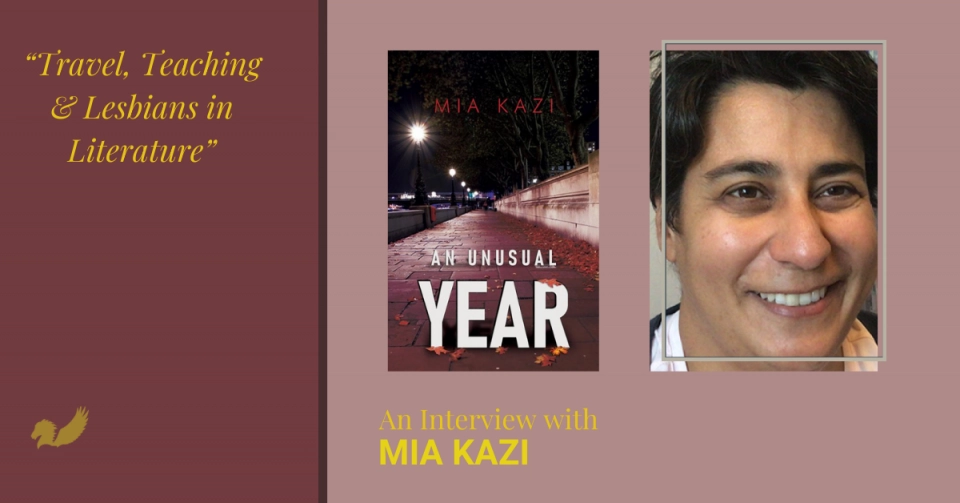
 We recently spoke with Mia Kazi, one of our fantastic LGBTQ+ authors, about how her extensive experience travelling has influenced her writing, her stances as a teacher on the importance of reading, her views on current LGBTQ+ literature, and the sequel to her debut novel.
Mia's first novel "An Unusual Year", published through Pegasus, can be found here, and the sequel, "The Faberge Egg", can be found here.
We recently spoke with Mia Kazi, one of our fantastic LGBTQ+ authors, about how her extensive experience travelling has influenced her writing, her stances as a teacher on the importance of reading, her views on current LGBTQ+ literature, and the sequel to her debut novel.
Mia's first novel "An Unusual Year", published through Pegasus, can be found here, and the sequel, "The Faberge Egg", can be found here.
 1). You have mentioned that you spent your twenties backpacking around Asia and Africa, and as a result have quite the catalogue of adventure tales and near-death-experiences to recount. How have those experiences informed the way you write, and the subjects you write about?
MK: I think travelling to different places and meeting different people enriches everyone. Asia in particular has a huge variety of cultures and in some countries you need to be alert for scams all the time and in others people are so welcoming. I was struck by how devastated Cambodia has been by its part but it has produced a people who are kind and grateful for everything they have left. That has left its mark on me. I loved travelling round Africa and particularly the amazing wildlife and having travelled round Syria and other middle eastern countries, it is painful to hear of the destruction and turmoil there and also to know that their stance on homosexuality means that it is now a risk travelling there with my children who have both of us named as mums in their passports.
2). Writing seems to be something that has been a great love of yours for much of your life. What are some of your earliest memories of discovering writing, and which authors and books inspired your interest in writing?
MK: I loved reading as a child and then entered some writing competitions and got published in the WH Smiths competition and won opportunites to meet authors. I make my kids enter some of those now and when they win or get commended or printed it enthuses them too. I was really inspired then but time and travelling took over and then I only came back to writing properly and edited some old work when I found some time again.
I had one of the early editions of War Horse when I was child and I read that and Mr Galliano’s Circus by Enid Blyton whenever I was ill or needed a comfort book. I recently met Michael Morpurgo with my kids at a book signing and he was warm and encouraging with a genuine desire to inspire others. He remembered the edition of War Horse I had and told me it would be valuable now, but it was so well read that it was fraying and torn when I finally parted with it. He is a really inspiring author. I also loved Dickens and the Brontes when I was younger, as well as Margaret Atwood, Jeannette Winterson, Pat Barker and P D James. I love it when one of my students or kids friends ask about writing and hope I can be someone’s inspiration too.
3). As a teacher, we would love to know; how critical do you think reading is in the life of a young person?
MK: I think reading is essential for so many reasons. The joy and escapism and the chance to “get to know” someone from a different background or universe. My children used to love being read to and now have their favourite authors that they love and get the new books for. Sometimes they lose interest and I don’t read or write for a while because I am busy so I make a conscious effort to be seen to read with them.
Reading books helps children imagine things outside their own world, understand and care about people and improves their vocabulary and grammar far more than they can learn in lessons at school.
4). Given that lesbian identity is at the heart of “An Unusual Year”, what do you think of the current state of LGBT literature, and what would you like to see more of?
MK: I think LGBT literature is getting better, certainly in terms of teen novels, but it isn’t anywhere near where it should be. For books to be profitable, they have to sell a lot of copies, so publishers are less willing to give book deals if they see something as a niche market. I used to think there were almost no books out there for people like me, but there are lots, they just don’t have mainstream deals and they aren’t promoted and marketed the same way. If you join an interest group, suddenly you find 100s of books, but without mainstream editing and publishing.
It’s the same with books featuring diverse characters. My son recently won £500 for his school library and the school told us we could help them choose books with diverse characters but it was very hard and we only spent a small amount of the money. It seems there are some books that are very conscientiously writing about this, but very few book deals are been given to books that just include people from a wide range of backgrounds. If children read about characters who were gay, lesbian, trans, refuges and so on, that would hopefully make them understand and empathise with people around them more. Particularly if the book wasn’t just about that, but a detective or adventure story as well.
The teen market is improving but it is still very much a narrow space.
5). “An Unusual Year” is certainly not the last readers have heard from Jo Briggs; you also released a sequel last year called “The Faberge Egg”. Could you tell prospective readers a little more about the sequel?
MK: “The Faberge Egg” picks up after Jo and Issy have moved in together. Jo is struggling to give up her freedom and they have to negotiate moving house together. In the middle of all this, Jo is given a Faberge Egg by a spiteful colleague to hide it from the police and they begin to realise that the egg is lost treasure that actually belongs to a Russian money laundering gang. Once again, Jo turns detective with the help of her police connections and Issy as well. However, this time she finds Russian oligarchs willing to buy her allegiance. Can she resist?


13 July, 2023