
They Could Hide Their Love In Plain Sight - An Interview with Summer Hayes
We spoke with Summer about her opinion of Lord Byron, how she crafted her leading men and how starting out her...
We spoke with Summer about her opinion of Lord Byron, how she crafted her leading men and how starting out her...

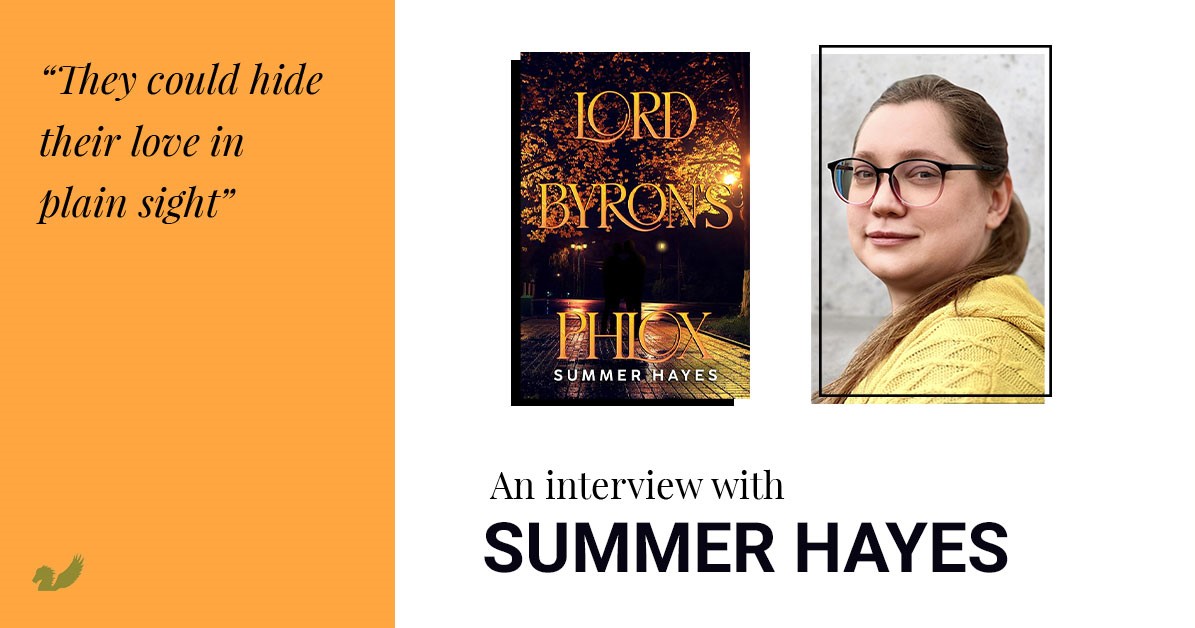
Everybody loves a juicy regency drama and romance, despite what they may otherwise say. The Romantic poets of the Victorian and Georgian period here in the UK are still well-respected and admired because their words still weave their way through our heartstrings.
None more so than the flirtatious and suave Lord Byron, whose work and notoriety directly lead to the creation of this LGBTQ+ romance by Summer Hayes – LORD BYRON’S PHLOX.
We spoke with Summer about her opinion of Lord Byron, how she crafted her leading men and how starting out her creative career in fanfiction helped her steer towards this finishing line.
---------------------------------------------------------------------------------------------------------------------------------------------------------------------
Lord Byron’s Phlox is a tender and delicately descriptive tale of forbidden romance - a wonderful LGBTQ+ fiction title. Where did you first come up with the idea of Jonah and Charles?
Honestly, when I came up with Jonah and Charles, I was inspired by a game I was playing at the time. It was multiple choice and the choices you made impacted the path of the game. But, there were times when I felt I was robbed of certain decisions and scenarios, and I felt like I wanted to provide that for people who deserved it. I admired one character’s softness and empathy, which I poured into Charles. Jonah was inspired by another character’s strength and integrity.
You’ve mentioned to us before that, like most of us, characters you can fall in love with are vital to a great escapist novel. How did you approach the crafting of Jonah and Charles as individuals and as a couple?
When crafting a character, you have to keep in mind the goals for their and desires and relationships at the end of a series or stand alone novel. Their backstories play a vital role. They dictate their decisions and their thought processes. For example, Charles has a deep-seated mistrust and fear of lawful repercussions, because he was very much aware of the laws prohibiting such romances as the one he would share with Jonah. A same-sex relationship is not new to Charles the way it is for Jonah, who approaches the whole thing with borderline naivety and sometimes fails to bear consequences in mind. This is somewhat of a source of tension, only possible when you bear in mind a person’s character and background.
I wanted Jonah and Charles to compliment each other, which I think I succeeded in doing. But, I also wanted them to have minds of their own with differing opinions and mindsets and talents. I didn’t want to write two peas in a pod because I wanted to highlight their individuality and the differences in their upbringing.
For someone to fall in love with a character, obviously relatability is the goal, so I made sure to bear in mind that their differing approaches to love came with its ups and downs, like any normal relationship would have. I feel like a journey of conflict and resolve really helps to bind a character to the page and in a reader’s mind.
The titular Lord Byron is one of literature’s greatest romantics – a flamboyant poet from the 19th century who was known for his impassioned sensibilities. How has Byron’s writing influenced your own and your love of literature as a whole?
I wouldn’t say Lord Byron influenced much of my writing, but he plays a significant part in the story, although he is not actually in it. Yes, Lord Byron was very popular at the time, but more than his poetry, his work becomes something of an inside joke to Jonah and Charles. Neither are a particular fan of his. Their opinion is largely based on his reputation - Lord Byron was often seen as somewhat vain, although brilliant and could be seen to be a man of excess.
He was, however, open when it came to romance. Because of his infamy, Jonah chose to hide the symbol of their unity - the phlox - inside a book of Lord Byron’s poetry. No-one in the house being a particular fan, it seemed to Jonah that no-one would notice a small book going missing from the shelves. By and large, the phlox travelled with either Jonah or Charles as a secret symbol of their love. One way or another, they would be with each other, always. That is the reason I chose to reference Lord Byron. They could hide their love in plain sight, in a sense.
Anime and fanfiction were where you started your writing journey. Are there any lessons that you learnt from adapting pre-written worlds and characters which have proved vital in your current work?
The biggest lesson I learnt when writing fanfiction was from reading it. In terms of setting, it was sticking to the rules of the universe set out before you. The rules of magic, or combat or the way physics did or didn’t work. Keeping in mind the architecture and the ecosystem was important too. Putting a desert where there wasn’t one can break the immersion, which you don’t want when you’re trying to pull a reader in. essentially, it forced me to learn about the setting and the way it functioned in the story, but it also taught me that not every story works with every setting. It showed me that I was capable of understanding someone else's world enough to portray what I wanted to without undermining the authors original intent for the world they created.
When I wrote my novel, I took many a break to research one thing that turned into a rabbit hole. For example, I wanted to know when a specific type of gun was invented, and then went further because the one that I wanted to hadn’t been invented yet. I needed to find one that was invented before or during 1828. I had to keep in mind that something as simple as an object that shouldn’t have been there could ruin a moment and take a reader out of the story. Historical accuracy in historical fiction is still important, even if you can suspend disbelief. History buffs who are fans of periods dramas or historical fiction/romance will notice.
But, if you must take pre-existing characters from their original setting, at least make sure their personalities are properly captured. I found that I was often complimented on how “real” or how “accurate” they felt. I suspect when writing those characters, one needs to have empathy for them, to understand them and make them feel real for yourself and your readers. I paid attention to their backstories, or extrapolated when there was not enough information. I had fun with what I did and didn't know about them.
To give an example, I once watched an anime where one character grew up without his parents. They had failed to come home and this character fixated on their absence to the point where he’d built puppets to replace them. As he grew, he developed an obsession with art (his puppetry) and the permanence of it. It was never stated, but I extrapolated that he was obsessed with the ever-lasting and permanence of art because he was still fixated on the absence of his parents. He was not a well-adjusted person, but I empathised because at the end of the day, he was a child who missed his parents. To this day he remains one of my favourite fictional characters. He was a great example of the way childhood trauma can affect a person in adulthood.
I believe empathy is just as important for writing original characters as well, if not more so. A sad backstory means nothing if an author cannot empathise. Emotionally intelligent people will likely pick up on what an author was trying to achieve. If an author isn’t particularly bothered, a reader will know. If you want to engender a particular emotion, you need to be able to understand the nuances of language. The right word or a well-timed sentence can really elevate a scene. On more than one occasion I felt myself get emotional over a few events in my novel. Sometimes, I felt giddy with emotion, other times, very sad. I hope beyond hope that when people read my story, they feel that too.
With original characters, the author is the one who sets the standard that fanfiction writers must meet if anyone does find that they want to write fanfiction at all. It was a big change for me, to go from having the safety net of a pre-existing work to having nothing at all, but I enjoyed the challenge. It was like taking the training wheels off, even though I often took characters out of their original setting. Inventing a person can be tricky, but rewarding. Unlike fanfiction, an author of an original work has to think of motivations, relationships, childhood, potential traumas or the lack thereof. Fanfiction certainly helped me to realise how much went into a character, and therefore people in general. It also taught me how easy it could be to draw on experiences from real life. It forced me to be a lot more creative when I was writing, because not everything you need in a story can be pulled from a world that already exists.
I have always loved world-building, perhaps more so than creating a character. That said, I love a good backstory. But, I think ultimately, what took me away from the world of fanfiction was that I could finally see what was missing, so when writing my own original work, I knew what I wanted from my own stories.
We loved reading along with Jonah and Charles and long for more tales and characters to fall head over heels for. Do you have any plans to revisit this relationship or are you looking elsewhere for your next novel?
There may be a time that Jonah and Charles do come back in another novel, but at the moment I only have plans for stories that follow other characters in the same universe as Lord Byron’s Phlox.
I don’t want to go too much into it, but at the moment, I am working on a story involving someone we have met before. Her story will highlight some of the trials of being a woman in the early 1800s, and the journey she went through to get where she was in Lord Byron’s Phlox. I still have a lot of work to do, but I am excited for the project!
.png)
Lord Byron’s Phlox is available now in paperback.

We are honoured to work with as many authors as we do at Pegasus Publishers – each with their own stories to tell. Their worlds are singular, their characters are relatable, and their creativity truly knows no bounds. This is Author Life, a feature on the Pegasus Blog that opens the door to each of our author’s creative process and previous literary experience, offering you – the reader – an opportunity to learn a little about the mind, or minds, behind the novel. Marius Shovlin ...

We are honoured to work with as many authors as we do at Pegasus Publishers – each with their own stories to tell. Their worlds are singular, their characters are relatable, and their creativity truly knows no bounds. This is Author Life, a feature on the Pegasus Blog that opens the door to each of our author’s creative process and previous literary experience, offering you – the reader – an opportunity to learn a little about the mind, or minds, behind the novel. Dylan Lee Henders...

There's something special for an author about seeing your book through someone else's eyes. Every review offers a unique perspective, highlighting the moments, characters, and themes that resonated most with a reader. We love sharing reader feedback, and this review of How Not to Have a One Night Stand by Elizabeth Ellen is one we couldn't wait to spotlight. Reviews not only help other readers discover new books, but they also offer fascinating insights into what captures people's imagina...
27 August, 2024