
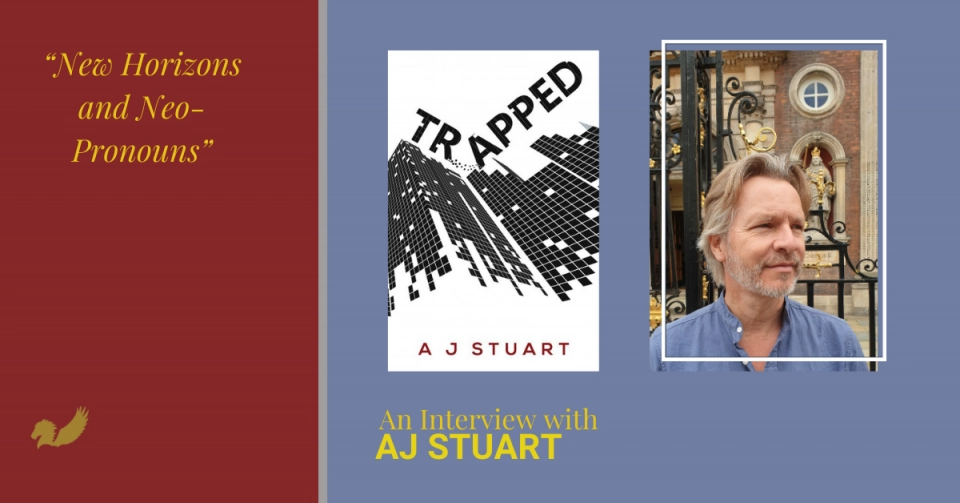
Looking to the future is equal parts exciting and horrifying. AJ Stuart's novel "Trapped" examines this closely, telling of linguistic evolution, environmental and economic decay, and a deadly new pandemic.
We spoke with AJ about how language spurred his interest in writing, his reading habits, his predictions for how language will develop in the coming years, and how being a part of the LGBTQ+ community informed the way he wrote the characters in "Trapped".
You can find the book here.
.jpg) 1). In terms of writing as a craft, you mention in your acknowledgements that writing was “something you had been putting off for a long time”. When/how did your interest in writing begin for you, and how long had the idea for “Trapped” been formulating?
AJS: Going back, I never really had an interest in writing, but I had an interest in language. It's language that interests me; the way people say things, the way people communicate. So, I came to it from a language perspective. I started writing a murder-mystery book in 2016 which is still on the back burner; I’ve come to realise that starting anything new is like making pancakes- you always put the first one in the bin! When COVID happened, I picked that book up again, finished it, but wasn’t overly happy with the finished product.
I read an article which advised authors to “write the book you want to read”, which was a turning point for me. I considered; what’s worrying me? What am I thinking about right now? What would make me look at a book and go “Oh I must read that!”? And that’s how “Trapped” came about.
2). One thing that we- and folks who have read and reviewed this book- love about it is the depiction of the future. It’s less about flying cars and more focused on how the status quo will evolve and develop (or devolve in the case of certain issues that we are facing). Was it ever difficult examining the most harrowing issues the world is currently facing and predicting how those things might develop if left unchecked?
AJS: No. I “check” rather than “research”, so I write the book first and get what’s in my brain onto the page. I’m nervous about reading books in the same genre because I think I’ll subconsciously copy them.
That’s the advantage of setting something in the future. If I was writing an historical novel I’d have to do the research first, whereas I have freedom to make stuff up and change whatever I’d like to change. I could get rid of the monarchy! (Spoiler: I don’t get rid of the monarchy.)
3). Genre-wise, the book inhabits the thriller genre, but also most definitely the dystopian genre too. The events in the book are largely based on things that are happening or have happened, but we must ask; in terms of literary inspiration, did you ever see yourself looking to any dystopian fiction? If not, who/what were your literary inspirations for this?
AJS: I actually didn’t read as a child; it was just something that our teacher’s made you do, kind of like it was done under duress. I took an interest when I went to university, reading Dick Francis-type books. My relationship with reading is sort of like going to the gym; I’ll go in phases where I don’t pick up a book for a year, and then suddenly I’ll read six books in three months.
I found myself in a reading community in Worcester, which has led me to meet a lot of local authors, and as a result I’m now working my way through a lot of different books.
4). Shifting focus to the LGBTQ+ aspect of the novel, protagonist Sam bears the pronoun ne/ner/ners/nerself, which is a kind of neopronoun that you have created to encompass the current “she, he and they” pronouns. How else do you think language might evolve in the coming years?
AJS: For those of us who are native English speakers, we’re very lucky. There’s few TV shows out there that haven’t been translated into our own language. What I find fascinating about English is how influenced it is, and I think I’d like to see the language adopt new words invented by the way other cultures speak English. It’s fascinating hearing the different ways other countries use English as a second language.
5). As someone who is part of the LGBTQ+ community, did you find yourself reflecting your own experiences in your characters at all?
AJS: No, although my first book is kind of autobiographical. In “Trapped”, I really enjoyed trying to put myself in other people’s shoes, but any readers who know me well might go “Oh that’s a very Andy thing to say/do” but I haven’t done that deliberately.
I write under then pen name AJ Stuart, but the book commences with a character named Andrew Brown, and he’s sort of an uber version of me in terms of charisma, presence and personality. So, there is a bit of me in there, but not reflected in the LGBTQ+ characters.
Being in the LGBTQ+ community, though, has allowed me to meet lots of people with different experiences, and has led me to read and watch things that share extremely personal stories, which definitely informed the writing of the book.
1). In terms of writing as a craft, you mention in your acknowledgements that writing was “something you had been putting off for a long time”. When/how did your interest in writing begin for you, and how long had the idea for “Trapped” been formulating?
AJS: Going back, I never really had an interest in writing, but I had an interest in language. It's language that interests me; the way people say things, the way people communicate. So, I came to it from a language perspective. I started writing a murder-mystery book in 2016 which is still on the back burner; I’ve come to realise that starting anything new is like making pancakes- you always put the first one in the bin! When COVID happened, I picked that book up again, finished it, but wasn’t overly happy with the finished product.
I read an article which advised authors to “write the book you want to read”, which was a turning point for me. I considered; what’s worrying me? What am I thinking about right now? What would make me look at a book and go “Oh I must read that!”? And that’s how “Trapped” came about.
2). One thing that we- and folks who have read and reviewed this book- love about it is the depiction of the future. It’s less about flying cars and more focused on how the status quo will evolve and develop (or devolve in the case of certain issues that we are facing). Was it ever difficult examining the most harrowing issues the world is currently facing and predicting how those things might develop if left unchecked?
AJS: No. I “check” rather than “research”, so I write the book first and get what’s in my brain onto the page. I’m nervous about reading books in the same genre because I think I’ll subconsciously copy them.
That’s the advantage of setting something in the future. If I was writing an historical novel I’d have to do the research first, whereas I have freedom to make stuff up and change whatever I’d like to change. I could get rid of the monarchy! (Spoiler: I don’t get rid of the monarchy.)
3). Genre-wise, the book inhabits the thriller genre, but also most definitely the dystopian genre too. The events in the book are largely based on things that are happening or have happened, but we must ask; in terms of literary inspiration, did you ever see yourself looking to any dystopian fiction? If not, who/what were your literary inspirations for this?
AJS: I actually didn’t read as a child; it was just something that our teacher’s made you do, kind of like it was done under duress. I took an interest when I went to university, reading Dick Francis-type books. My relationship with reading is sort of like going to the gym; I’ll go in phases where I don’t pick up a book for a year, and then suddenly I’ll read six books in three months.
I found myself in a reading community in Worcester, which has led me to meet a lot of local authors, and as a result I’m now working my way through a lot of different books.
4). Shifting focus to the LGBTQ+ aspect of the novel, protagonist Sam bears the pronoun ne/ner/ners/nerself, which is a kind of neopronoun that you have created to encompass the current “she, he and they” pronouns. How else do you think language might evolve in the coming years?
AJS: For those of us who are native English speakers, we’re very lucky. There’s few TV shows out there that haven’t been translated into our own language. What I find fascinating about English is how influenced it is, and I think I’d like to see the language adopt new words invented by the way other cultures speak English. It’s fascinating hearing the different ways other countries use English as a second language.
5). As someone who is part of the LGBTQ+ community, did you find yourself reflecting your own experiences in your characters at all?
AJS: No, although my first book is kind of autobiographical. In “Trapped”, I really enjoyed trying to put myself in other people’s shoes, but any readers who know me well might go “Oh that’s a very Andy thing to say/do” but I haven’t done that deliberately.
I write under then pen name AJ Stuart, but the book commences with a character named Andrew Brown, and he’s sort of an uber version of me in terms of charisma, presence and personality. So, there is a bit of me in there, but not reflected in the LGBTQ+ characters.
Being in the LGBTQ+ community, though, has allowed me to meet lots of people with different experiences, and has led me to read and watch things that share extremely personal stories, which definitely informed the writing of the book.



26 June, 2023