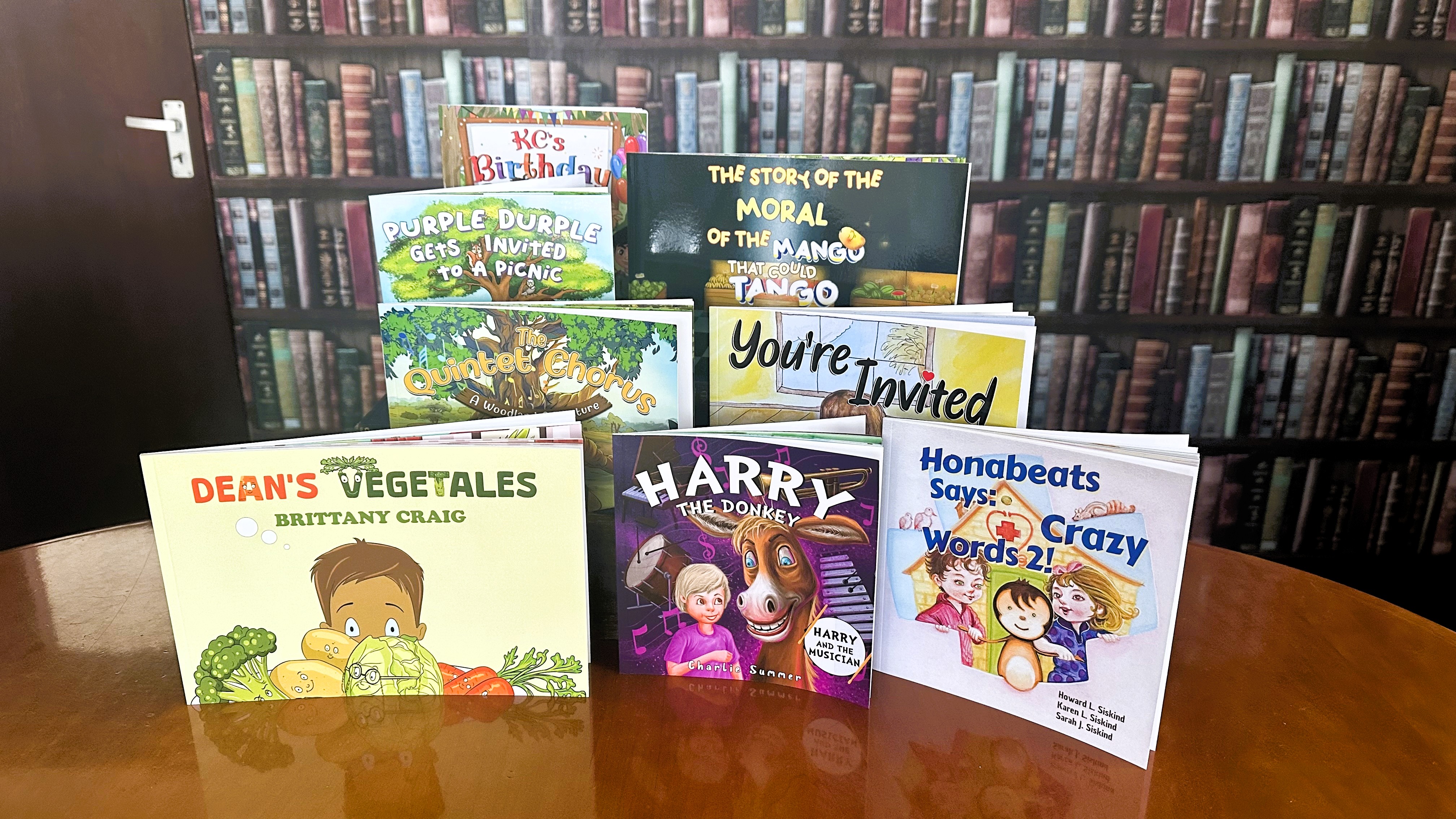
Thursday March 6th is World Book Day – ironically, only truly celebrated in the United Kingdom. As a British based publishing house, we are celebrating this day with an extra special collection of children’s publications!
Our World Book Day 2025 releases are designed to celebrate stories and encourage reading for our youngest fans. In anticipation of their imminent release, we have reached out to our eight World Book Day authors to discuss all things children’s books…
This World Book Day, we would like to celebrate children’s books and encourage children to read more often. Were you an active reader when you were younger?
Brittany Craig, author of Dean’s Vegetales - I was a very avid reader when I was younger, often reading for hours at a time while my sisters played outside. I used to come home from school, grab an afternoon snack and curl up on the couch reading until dinnertime. As an adult, I wish I still had what felt like unlimited hours to read, but I do always try to set aside time and make it a habit to read before bed.
Charlie Summer, author of Harry the Donkey – Harry and the Musician - When I was younger, I was an obsessive sports enthusiast. Therefore, my reading was avidly geared towards this interest. I read football weekly magazines such as “SHOOT”, and football annuals such as “SCORE”, “SOCCER GIFT BOOK” and “ALL STARS”. As I reached my teens, my sporting interest remained, but I also started to enjoy classic novels such as 20,000 Leagues Under the Sea, Around the World in 80 Days, Treasure Island and Last of the Mohicans.
Howard Siskind, co-author of Honabeats Says: Crazy Words 2! - My daughter Sarah (one of my co-authors) was an extremely active reader, not only as a child, but also into her adult years, and is now in college. She is never without at least one book in her hand. At restaurants she would sit at the table reading a book. Because of her skills, she was able to enter advanced programs in both Middle School and High School.
DF Wilson, author of KC’s Birthday Bash - Yes. I grew up in the British School system via Jamaica West Indies. We had to read every day throughout the school year. Most of what I read was geared toward K through 12th grade.
Sherry W. Ramsey, author of Purple Durple Gets Invited to a Picnic - I was not an active reader until I became a young adult. My reading skills did not develop well until my later years, so I would encourage all children to practice reading as much as possible, as they would be greatly rewarded all through their lives.
Ricky Elliott, author of The Quintet Chrous – A Woodland Adventure - You bet I was. My earliest recollection of reading were Janet and John books, Ladybird fairy tales and Enid Blyton’s Famous Five and Secret Seven Stories. I had a school friend who had the complete collection of both sets of stories and I used to borrow them to improve my reading ability. When I moved to junior school, the books I remember well were Stig of the Dump by Clive King and The Chronicles of Narnia by C S Lewis. I will never forget these books, which basically opened my world to books and the love of reading.
Phil Green, author of The Story of the Moral of the Mango That Could Tango - Yes, I was. I loved the classic chapter book stories that were popular when I grew up, but I also remember we had a set of Encyclopaedia Britannica that fascinated me with all the pictures, cut away diagrams and maps. I loved maps and placing the names of countries and cities and all the geographical features of the world, also the diagrams of the human body showing the internal organs and muscles and bones etc. I read books from some classic Enid Blyton stories, like Shadow the Sheep Dog, to the thrilling adventure books of Alistair Maclean.
Melissa Fisher Paoni PhD, author of You’re Invited - When I was a child, reading was a way of obtaining information, enjoying a retreat from real-life stress, and connecting socially. Receiving a copy of Highlights magazine in the mail was fun but also important because it was MINE! Feeling ownership over my reading choices felt amazing as a kid. My friend group would share books and eagerly discuss them. One that I can recall that was an essential coming-of-age book was, Are You There God? It’s Me, Margaret by Judy Blume. I also can recall lying on the carpet with an Encyclopaedia Britannica open as I read through various topics…yes, I was somewhat of a nerd.

Do you have a favourite children's book that you would encourage all young readers to pick up?
Brittany Craig - The book that always springs to mind when I think of reading as a young child is Witch, Witch Come to My Party by Arden Bruce. The book is about a series of people and creatures who are invited to a party, with each character’s acceptance to the party dependent on someone else being invited. The predictable pattern and rhythm to the story, along with striking illustrations and a little twist at the end, make this a really fun, entertaining book for young readers.
As I got older, I became a massive fan of the Babysitters Club series by Ann M. Martin, anything written by the incredible Jacqueline Wilson and I also inevitably jumped on the Harry Potter train (starting with the third book, as that was the first one my older sister owned, strangely).
Charlie Summer - For me, any book by Jules Verne for the young reader who is looking for unique adventure and daring. 20,000 Leagues Under the Sea, Around the World in 80 Days and Journey to the Centre of the Earth stand out for me. Also, Enid Blyton, in particular, anything from the Famous Five series would be enjoyable for the young reader. This series was wholesome, genuine and relatable adventure stories. I think Enid Blyton is arguably the finest author of children’s books of all time.
Karen Siskind, co-author of Honabeats Says: Crazy Words 2! - I would encourage young readers to select the Dr. Seuss book Mr. Brown Can Moo! Can You? The book has cute rhymes and will help young readers with asking questions, being interactive and inquisitive.
DF Wilson - Yes. KC’s Birthday Bash is a fantastic children’s book that I encourage ALL young readers to pick up – primarily because it is relevant to how we operate in today’s society. Our society is based on external optics and competition. As a result, young people are apt to adopt a sense of entitlement - believing that mom and dad should give them whatever they want. Sometimes these requests go beyond the grain of the family budget – exceeding what they family’s household budget can afford. KC’s Birthday Bash teaches young people that sometimes they have to accept what mom and dad can afford to give them and to make the most with what they have… and that doing this can indeed yield positive results.
Sherry W. Ramsey - My favorite book that I would encourage to all is The Giving Tree by Shel Silverstein. This is a wonderful book and teaches a life lesson.
Ricky Elliott - One book which I would encourage all children to read (and adults) as well, is The Silver Sword by Ian Serraillier, which is a superb adventure from start to finish. Based upon true life events, even though the character names are fictitious, The Silver Sword is the story of three Polish children - Ruth, Edek, and Bronia - who are separated from their parents during World War II and must navigate the ruins of war-torn Europe to find them. Guided by a paper knife shaped like a silver sword that belonged to their father, which they believe is a sign he is still alive and searching for them; they join forces with a young orphan named Jan, who possesses the silver sword, and together they embark on a perilous trek across Europe to hopefully reunite with their family.
I read this at junior school, and it has remained a truly great story to date. Borrow it from a library or buy a copy from your local bookshop. You won’t want to put it down once you start reading it.
Phil Green - The book that absolutely captured me was The Hobbit by J R R Tolkien. My brother gave it to me when I had the mumps at nine years of age. I was bedridden for a week or so and I could not put it down. I remember being sad when I finished the book as the images it evoked were so vivid, I just wanted the story to go on and on. Actually, I wanted to be there in the book.
I later read The Hobbit to my own children when they were small, and I was able to relive the adventure and excitement again through the wonder and excitement they expressed listening to me reading it. The story is timeless and will appeal to kids and adults alike for as long as people read. My son in particular loves reading to this day.
Melissa Fisher Paoni PhD - I have many favorite children’s books, but most have themes of recognizing the power of being yourself, such as A Bad Case of Stripes by David Shannon, positive self-talk, such as I Can Handle It by Laurie Wright, and inclusivity, such as The Invisible Boy by Trudy Ludwig.
I feel strongly that telling stories is an influential way of introducing important topics to children that reflect the foundational values of kindness and standing up for the right thing. The book I am currently working on, Allie is an Ally, involves a child becoming aware of racism and feeling empowered to stand up against racist comments while understanding that we can all be allies for each other.

Why did you choose to write your children's book? Who or what inspired your writing?
Brittany Craig - I’ve always enjoyed rhyming for family and friends’ birthday cards and speeches, but this is the first time I’ve written a fictional story that rhymes. I started writing the story a few years ago, using my eldest nephew, Dean, as inspiration. I don’t recall Dean ever being particularly resistant to eating vegetables, but I don’t think he particularly loved them either!
It’s pretty standard for children to not like vegetables, and while the story is fairly exaggerated (what 4-year-old child is given a large plate of just vegetables for lunch, including a whole broccoli and whole cabbage?), it’s intended as a fun and educational way to encourage kids to eat their greens and realise that not only are they good for you, but they can taste pretty delicious too.
Charlie Summer - When my children were young, there were not any published characters that completely captured their imaginations. Following a family day out at a working farm, I began to make up stories about a donkey called Harry. His adventures were a little crazy (such as waterskiing!!!!) but by adding participation to the stories (for instance, my children would pretend to waterski with Harry whilst stood on my feet) their popularity rose. When I retired, I decided to try and bring Harry’s adventures to the children’s book world.
Howard Siskind - The Honabeats series of books was inspired by my wife, Karen, and daughter, Sarah. They provided most of the fun and “crazy” words in the books. The words lived on a list in my desk drawer for years until I started thinking of fun poems and sketches to go along with them.
DF Wilson - I am a single dad who had to raise my son on my own. When I moved to Arizona from New York City, I had to cut corners and tighten my belt in order to make my household budget work. Time and time again, I had to explain to my young son why I couldn’t, for example, give him that $150 pair of sneakers when my budget could only afford a $80 pair. In this case I had to explain that the sneakers were pretty much the same and that the Air Jordans cost more because of the name attached to it. My son gained understanding of what managing a household budget meant.
Sherry W. Ramsey - I have always had a very creative imagination, as well as a desire to bring joy to others by entertaining them, writing gives me the opportunity to encompass both.
Ricky Elliott - It was basically during lockdown, following the recent COVID pandemic and my mum inspiring me to give writing a go. My book is dedicated to her. The inspiration for writing my book was Sir David Attenborough and a documentary he presented on the disappearing Amazon Rain Forests. Having researched this subject in more detail, the Amazon is of vital importance. People around the world depend on the rainforest, not just for food, water, wood and medicines, but to help stabilise the climate.
Tragically because a large amount of the Forest is being destroyed or converted to other uses so fast, we may never know how many new species of animal or plant are contained within it. This forms the basis for my book. The attempted destruction of a woodland, ensuring the removal of wildlife and how this would affect their community (the Chorus) in the future.
Phil Green - I chose to write my book for a couple of reasons...
1. to show my kids where books came from... it sounds silly, but I wanted them to understand that books only exist because somebody writes them.
2. to write a specific story for them and that related to their experiences. Getting little kids to eat and enjoy eating fruit and vegetables is always a bit of challenge so I tried to create a story that made those items humorous and fun and part of another conversation other than just having to 'eat your vegies at dinner time'.
3. to (hopefully) illustrate the fun that can be had with words and languages through exploring the different meanings that words possess, the different ways of pronouncing some words, the different meanings this might give them and the funny situations that can be imagined by exploring these things.
As my story developed, I found I was writing a second layer of story, about being spontaneous, adventurous and being prepared to be a bit different from the crowd without worrying about what others might think. I believe it is important to think independently and not just blindly follow what 'the group' does. The work that was most inspiring for me at the time I started to write my own book was The Sign of the Sea Horse by Australian author Graeme Base. It is a beautifully illustrated and written story of rhyming verse that our kids enjoyed very much.
Melissa Fisher Paoni PhD - I chose to write You’re Invited after hearing multiple stories from my paediatric patients about profound distress related to being socially rejected in one form or another. Many children have shared experiences of having their expectations of friendships being dashed, being excluded, and feeling insecure, which can follow them for years. This book can serve as a social story to promote validation of a variety of feelings and to generate positive problem-solving.
You’re Invited has a cameo of Wally the Worrier, a character from my previous book, Dylan’s Hero: A Story of Overcoming Negative Thinking, encouraging readers to shift away from negative thinking, towards more adaptive self-talk. Themes of kindness, inclusivity, and self-confidence are also included.

Have you had the opportunity to share your work with any young readers yet? What did they think? What do you hope young readers get out of your story?
Brittany Craig - Before it was published, I shared the story with my nephew, Dean, who loved it - I think he was pretty chuffed at being the inspiration for main character. So far, Dean is the only child who has heard the story, so I’m very excited to share it with other young readers, particularly my nieces and nephews - I now have eight! I’m sure they will have some honest feedback and questions for me!
Charlie Summer - I have read Harry’s adventures to my grandchildren, and they loved them very much. I would like to write stories where the young reader can participate in the story. For example, counting down for the rocket to take-off in Harry and the Rocket. My books are intended as bedtime stories, lasting enough time for parents and children to enjoy a good old-fashioned adventure. In addition, I’d like to encourage young readers to learn and open new fields of adventure for them. Rockets, musical instruments, cowboys and country gardens are fun, diverse but interesting areas in which to discover and learn.
Howard Siskind - YES! Young readers enjoy the “crazy” mixed-up words and fun graphics. It’s a learning tool for them for word completion and phonics. As such, many grade schoolteachers have been using the first book in their classrooms.
DF Wilson - Yes. I have shared my work with younger readers and adults – through my church and I have received lots of positive feedback. They appreciate the moral of the story.
Sherry W. Ramsey - I have had the opportunity to share this book, and other stories with young readers when I worked part-time at the school library. Children really enjoyed my stories and were always looking forward to hearing more from my collection.
Purple Durple Gets Invited to a Picnic is a short, whimsical and rhyming book. I wish it brings a bit of entertainment to readers, as they get intwined with the fun and brief time with the characters.
Ricky Elliott - No, not yet, but I will do so in the next few weeks and months ahead. I hope that younger readers will remember the characters in the book, the adventures they are having and the true meaning behind the story. Preserving the environment for future generations. I hope they will laugh and cheer for the characters, and once they’ve read the book, come away with a big smile on their face! It is very important for children to learn more about where they live. Rivers, trees, woods, the land and most importantly, how these elements must be protected for their generation and for generations to come.
Phil Green - Everyone, even the adults, have had a good laugh when reading my book. One thing I've noticed is that different age groups get different stories from my story about this dancing Mango, because as they get a little older, they understand the way language plays with the words in the story, which gives some funny and cheeky results.
I hope young readers get several things from reading my book:
Firstly, and foremost, I hope they have fun and laugh and imagine things they might not have otherwise imagined, like a mango doing the tango by himself. If that's all they get from it, I will be very happy.
I also hope reading or listening to this story helps inspire them to read all sorts of other books and develop a lifelong passion for reading.
However, I consider the highest and best outcome for the slightly older readers would be to spark a sense of adventure, spontaneity and creativity despite the challenges these actions can sometimes trigger. Understanding that following and living one's passion can be challenging for others to accept, but that that should not stop them. A sense of tolerance and acceptance for allowing others to harmlessly follow their passions might make the world a happier place.
Melissa Fisher Paoni PhD - I have read this story to my elementary-age patients, and the feedback has been positive. Young readers have mentioned that the multitude of feelings in the story - including pride, excitement, anger, sadness, nervousness, and contentment – are all relatable. Without giving away too much of the plot, one youngster who experienced rejection actually chose to follow the plan of the main character and host a party where he and his friends collected food for the local food pantry. My hope is that young readers feel validated for any feelings experienced when exclusion occurs and that they feel empowered to create plans based on kindness and support of each other, even when that means being different.

Finally, in a world where fewer and fewer children are picking up books, can you share some words of encouragement to young readers about the benefits of reading?
Brittany Craig - Getting lost in a book is such a great form of escapism. It’s infinitely better than TV as there are no limits to the visuals you can conjure up when you read. Reading is also a great way of improving your vocabulary range – you come across all sorts of new words that you might otherwise not be exposed to in day-to-day life.
Charlie Summer - The endless range of published subject matter, genres, characters and scenarios would enable any young reader to find their own special happy space. In the age of digital and mobile technology, to take some quiet time out with a good book, enables the young reader to escape to their own special place where they can read about what makes them happy, or learn about something that they would like to achieve, or just get lost in their own fantasy world……the options are endless.
Sarah Siskind, co-author of Honabeats Says: Crazy Words 2! - I would like to encourage young readers to seek out their librarians in schools and public libraries. They are very helpful and knowledgeable about what books to read. They will suggest many fun topics so you can better enjoy and benefit from reading.
DF Wilson - Reading is having fun. You will have fun when reading KC’s Birthday Bash because you’ll be rooting for KC to pull off a better birthday party than the birthday party, he had the year before. Reading activates the mind and helps to balance your mind between playing video game and reading. Reading stimulates the intellectual side of your brain and enhances your brain power.
Sherry W. Ramsey - I would love it if more children would develop good reading skills and learn how easy it is to be entertained by getting lost in a different world as they read. Reading can be so entertaining and satisfying, as well as having the world at our fingertips, to learn about almost anything.
Ricky Elliott - Remember that learning to read will play a very important role in your life. Escape into a world of adventure, fantasy, excitement, danger and wonder by the books you read and come on the journey of a lifetime. The more you read, the more you will learn about the world in which you live. Truthfully, you won’t be able to take any exams in later life unless you learn to read, and more importantly, if you want to learn to drive when you are older, you will need to take a written examination first. If you can’t read this won’t happen.
Phil Green - The benefits of reading cannot be imagined or fully appreciated until someone has actually engaged in a book. They include:
Nurturing imagination and creativity - while the central plot will be the same for different readers, the same words will conjure different images for different people, and many details of a story will be unique to the reader. Everyone can exercise their imagination to create and fill in the hundreds of details that are not specifically explained in the text.
Improve vocabulary and writing skills - reading, learning and using new words, whether speaking or writing, and exploring different ways to express oneself is a skill that has benefits well beyond reading. Being able to deliver a story or a message to an audience, in an interesting and engaging manner is an important skill that applies to everything we do in life.
Friendship and confidence - the common ground that readers find around a discussion about a book they have read, separately or together, leads to friendships that go way beyond reading. Recommending to people books that you have read is also a great way to expand your friendship base, discover new subjects and cultivate a positive and happy state of mind.
Calm, Focus and Stress Management - in a world of constant and sporadic stimulation from social media, finding time to unwind, be calm and focus on one subject is increasingly difficult. Reading allows you to be physically quiet, to settle into a calm state and to concentrate on any subject of your choice for a longer period, which in turn provides a greater sense of enjoyment and achievement than incessantly flicking across endless social media channels.
Melissa Fisher Paoni PhD - Reading is such a great way to activate young brains! We know that reading improves cognitive development, language skills, empathy, and imagination. In this device-driven world, taking technology breaks by doing activities, including reading, is critical for building pathways in the brain and ensuring a healthy mind. So kids, in other words, reading relates to being SMART, KIND, and CREATIVE!
A massive thanks to all our World Book Day authors for answering our questions and celebrating all things children’s books!
Just like Melissa said, reading makes you smarter, kinder and more creative, which is why at Pegasus Publishers, we see reading as a hugely important and worthwhile pastime for everyone – not just our youngest readers.
This World Book Day, please take some time, curl up into a cosy reading nook, and get lost in the endless joy of your favourite book.
Happy World Book Day!



04 March, 2025