We are honoured to work with as many authors as we do at Pegasus Publishers – each with their own stories to tell. Their worlds are singular, their characters are relatable, and their creativity truly knows no bounds.
This is Author Life, a feature on the Pegasus Blog that opens the door to each of our author’s creative process and previous literary experience, offering you – the reader – an opportunity to learn a little about the mind, or minds, behind the novel.
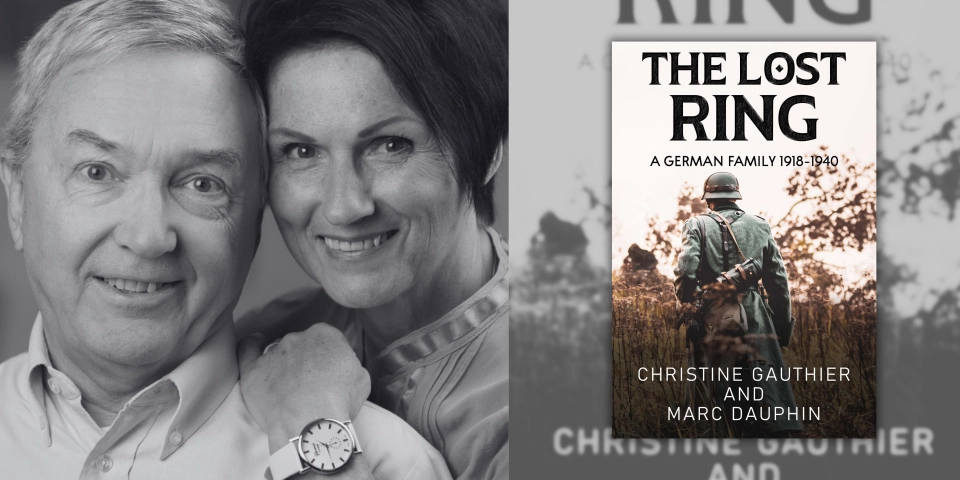
Christine Gauthier and Marc Dauphin are the authors of the post-World War 1 historical fiction novel ‘The Lost Ring’.
What are the three most important things you have accomplished, aside from publishing a book?
Christine: a) Learning English, German and Italian. b) Getting a university diploma. It has helped me understand the wider questions of History and how to better nuance things. c) Working as an RN. It has helped me better understand human nature.
Marc: a) Marrying Christine. Without her, the final version of this story would have been impossible. She has helped me to persist in learning the basics of that most difficult profession: writing. Critiquing and correcting my drafts. For seven years. b) Enrolling in the Canadian Armed Forces at 19. They supported me throughout my medical studies and then, formed me into military medicine. They also gave me a chance to excel on the world stage. c) Becoming an emergency physician and a coroner showed me humans during their worst days.
In your own life, what influences and inspires you to write?
Christine: The “Effective writing” course I attended at Bishops University changed my outlook on the art and discipline of writing and molded me into what kind of writer I am today. Thank you, Professor Sandra West.
Marc: Reading Erich Maria Remarque as an adolescent. The contrast between poignancy and banality was overwhelming for a teenage mind thirsty for love.
What book or author has had the biggest impact on you and why?
Christine: Émile Zola’s Rougon-Macquart literary cycle is filled with strong, well-defined female characters I could easily relate to. Gervaise Macquart’s slow descent into hell was a marking story.
Marc: After EM Remarque, who opened up a window on German society and way of thinking during WWs 1 and 2 and the interwar years, Herman Wouk, was influential in motivating me to write multi-character and multi-scenic, wide, panoramic, yet intimate stories (“The Winds of War” and “War and Remembrance”), plus the value of such a tool (the novel) to teach History to a wider public. And lastly, Len Deighton, for having dared to broach the subject of Nazi Germany as a source for un-cartoonish Germans (“Winter,” “Bomber,” “Declarations of War”). And, of course, Zola, Leon Uris, Edward Rutherford, and Ken Follett.
How would you summarise your book?
The Lost Ring follows a German working-class family from Dresden, from December 1918 and the return of the father, Josef Kempfe, a survivor of four years in the trenches of the Great War, to Christmas 1940, when his second son Emil returns home from the conquest of France. In between there will be famine, disastrous inflation and the Great Depression, as well as the political chaos that led to Hitler’s election. Away from the greats of History, the Kempfe family’s four sons survive, grow up into men and embrace their destiny as they deal with the obstacles life in Germany places before their paths. From bullying to poverty and rioting in the streets, there are love stories, hope, determination and the eternal longing for justice and goodness that guides the lives of men.
What were your first experiences with writing?
Christine: I never considered writing in uni. My first assingnment was traumatisant: demeurer de longues minutes devant une feuille blanche fut une véritable torture. Ce qui j’ai appris : aller au plus profond de soi afin de découvrir les émotions cachées, les douleurs niées et l’humilité. Merci Sandra Ward [Translation: My first assignment was traumatic: sitting for long minutes in front of a blank sheet of paper was pure torture. What I learned: to delve deep within myself to uncover hidden emotions, denied pain, and humility. Thank you, Sandra Ward.]
Marc: When I was seventeen, I set out to write a great, dramatic novel about a love story. My aunt, an experienced journalist at the time, and our family’s utmost authority on writing, read the first hundred pages: “Not bad, but it does show that you’re seventeen.” It took me another twenty years before I tried again.
In your opinion, what are the key ingredients for a good story or novel?
Both: Believable and complete characters placed in difficult situations during interesting times/events. Good rhythm (alternate fast-paced with slow and introspective) and great love stories (not necessarily the sex).
How long do you spend writing every day?
Both: one or two hours.
How long did you spend writing this novel?
The French version took seven years. Three one thousand drafts, each one from a blank page. Two more years to translate it, and another year and a half correcting it under supervision.
What was the most challenging part of writing this book, and what did you learn from writing it?
Christine: Developing and refining the characters to ensure they are as credible as if they were alive, sitting right next to you. Characters do not develop through introspection and long soliloquy but through their reactions to events and their subsequent actions.
Marc: The historical details. Every time one thinks History is clear-cut, there are two or more versions of the same event. And a thousand different little sub-events that influenced the ultimate outcome. Then, there is the fact that History evolves as years pass and historians wade through reams of documents and come up with new facets to historical events.
What did you find most helpful when writing this book?
Christine: The abundance of historical data available today, and which was absent thirty years ago when we started. Today, one can consult the daily papers for contemporary views of events just happening. Now, one can know what songs were playing on the radio, what side events distracted people from the main ones, what was the weather, how were they dressed, how much did it cost.
Marc: Irritants in many historical novels are authors who want their characters to think as people do today, or who criticize your characters for not being woke enough. This was the thirties or the forties! They were far from being able to think as openly as today.
What writing advice would you offer to your younger self?
Christine: Start writing. Now. There are gems hidden inside your mind.
Marc: Marry Christine.



04 June, 2026